
Flow•Hold•Infil: Integrated Subsurface Stormwater Management Systems
A complete underground toolkit for LID & BMP compliance. From heavy-duty detention tanks to high-efficiency infiltration modules and leaching chambers. AASHTO H-20/HS-25 traffic rated.
Core System Specifications
95–97%
Effective void ratio
200–800 kN/m²
Module Strength (Traffic Load)
DN100–800
Pipe Connections
H20–H25
AASHTO Load Rating
0.30–1.50 m
Typical Cover Depth
2–3×
Storage Capacity (vs Stone Trench)
System Flow Sequence
- Shallow Layer: Utilizes products like Integrated Shallow Geocellular Solution for rapid surface runoff interception and sub-grade drainage.
- High-Volume Subsurface System: The primary structure for engineered capacity and load is chosen based on required geometry:
- Geocellular Tanks: (Best for H25 Load / Deep Burial / Modular, irregular plots)
- Stormwater Modules:(Best for High-void crates / Scalable stacks/half-layers)
- Stormwater Chambers: (Best for Low Profile Sites / Row geometry for corridors)
- Wrap with Geotextile for infiltration basins (groundwater recharge)
- Wrap with Geomembrane for watertight detention tanks.
- Controlled Release (Detention/Retention): Lined systems use orifice/vortex control to regulate outflow, enabling flood mitigation or rainwater harvesting.
- Emergency Bypass (1% AEP Compliance): Defined overflow systems ensure flows exceeding the 1% Annual Exceedance Probability (AEP) design standard (100-year storm) are safely conveyed away from critical infrastructure.
Core Components of the F•H•I System
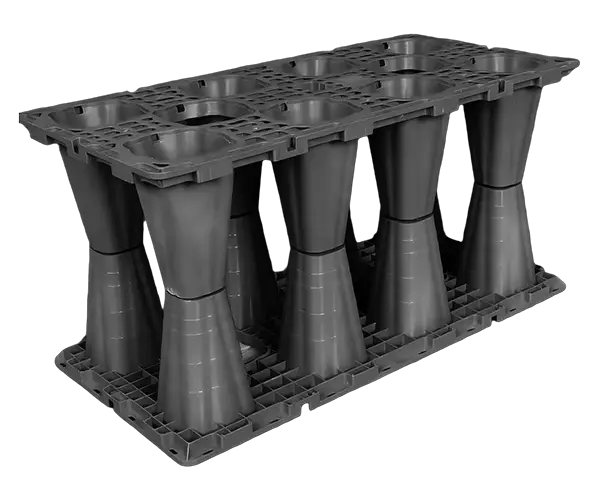
High-strength (HS-25) structural tanks for heavy traffic areas, airports, and deep underground attenuation.
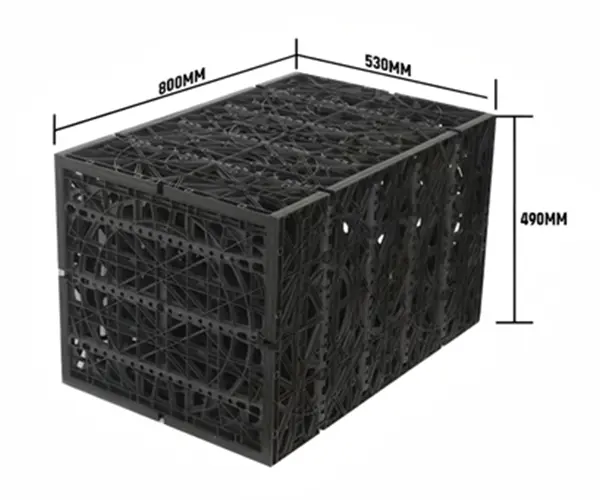
Stackable, high-void (97%) modules for LID infiltration trenches and bio-retention cells. AASHTO H-20 rated.
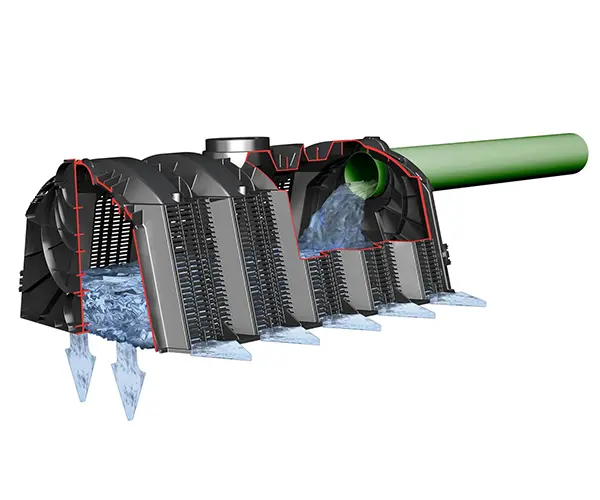
Arch-shaped chambers for septic drain fields and linear roadway drainage. Cost-effective alternative to pipe and stone.
| Aspect | Geocellular Tanks | Geocellular Modules | Stormwater Chamber |
| Primary Role | High-Capacity Detention/Storage | High-Efficiency Infiltration/Attenuation | Low-Profile, High-Flow Rate |
| Structural / Load | H25 Heavy-Duty (Up to 800 Kn/m²) | H-20/HS-20 Medium-Duty (Up to 600 Kn/m²) | H-20/HS-20 Medium-Duty (Up to 600 Kn/m²) |
| Ideal Application | Heavy Traffic (Truck Lanes, Ports) | Parking Lots / Landscaped Areas | Linear Projects / Depth-Restricted Sites |
| Geometry / Flexibility | High Flexibility (Irregular Plots) | High Scalability (Multi-Layer Stacks) | Row Geometry (Corridors) |
| Key Value Summary | Extends Heavy-Duty Pavement Life | Provides Sustainable Groundwater Recharge | Reduces Excavation Depth & Costs |
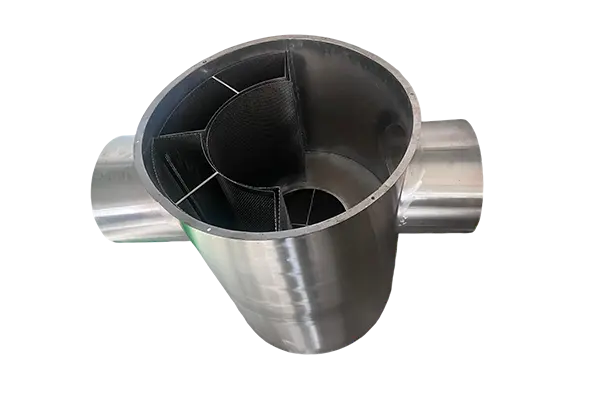
Aqua StormFilter
Cartridge/basket filtration upstream of the shallow raft to capture silt and hydrocarbons.

Geomembrane
Creates detention zones; use welded seams and protection layers per specification.

Geotextile
Filter/separator enabling infiltration while controlling fines (select weight & AOS by soil).
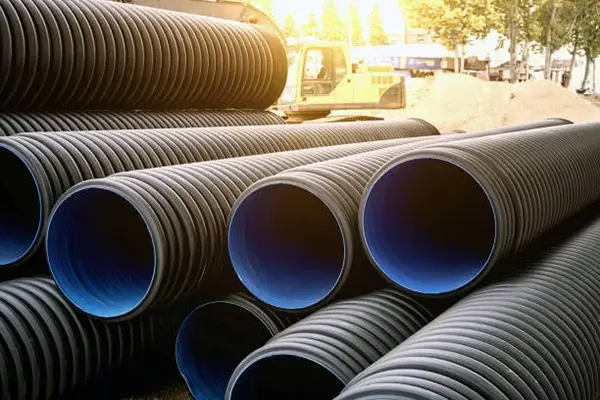
SN8 Pipe
Outlet conveyance or bypass; connect via shallow inspection boxes with throttled discharge.
Applications

Parking Lots
Meet discharge limits with underground detention; H-20/HS-25 rated for traffic loads.

Roads & Streets
Highway drainage corridors; curb inlets connect to linear chamber or tank galleries.

Logistics & Yards
Heavy industrial pavement support; decentralized infiltration cells for large roof areas.

Urban Hardscapes
Shallow-cover storage for LID and podium projects.

Campuses & Healthcare
Creates detention zones; use welded seams and protection layers per specification.

Sports & Recreation
Filter/separator enabling infiltration while controlling fines (select weight & AOS by soil).
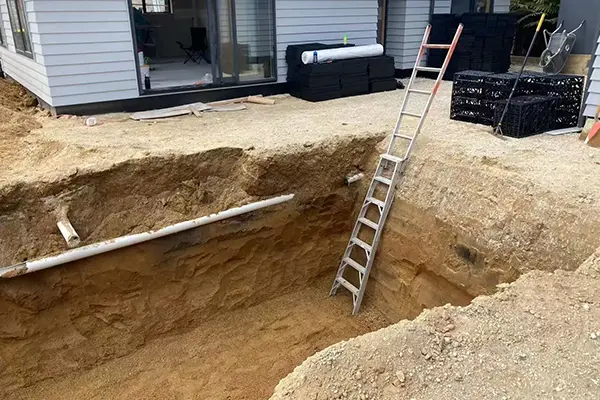
Residential Dry Wells
Backyard infiltration systems for roof gutter runoff and driveway drainage.

Transit & Park-and-Ride
Outlet conveyance or bypass; connect via shallow inspection boxes with throttled discharge.
Installation Guide — Infiltration First, QA/QC Controlled
1) Pre-construction Controls
- Approve submittals: device layout, wraps, SN8 specs, orifice/vortex details, O&M plan.
- Site checks: utilities, survey, seasonal GWT, soil ksat, setbacks; confirm exceedance route.
- Hold points: bedding approval, liner weld/boot tests, manifold pressure/leak tests.
2) Excavation & Dewatering
- Excavate to design line/level; proof-roll; remove soft spots and replace with engineered fill.
- Provide temporary dewatering where GWT is near base; keep liner works dry and clean.
3) Bedding & Subgrade
- Granular base (tanks/crates) or washed stone (chambers); level and compact per spec.
- Protect geotextiles from mud/fines; prohibit traffic on unprotected base.
4) Wraps & Device Assembly
- Infiltration: Non-woven geotextile envelope; lap joints ≥300 mm; secure to prevent bridging.
- Detention/Retention: Geomembrane + protection geotextile; QA welds (air-channel/spark tests); boot all penetrations.
- Place modules/rows per manufacturer spacing; maintain alignment and interlocks.
5) Manifolds, Controls & Access
- Install SN8 headers/laterals; gasketed joints; torque per spec; pressure/leak test.
- Fit orifice/vortex device; set invert elevations; install inspection risers & cleanouts; isolator row for chambers.
6) Backfill, Surface Works & Commissioning
- Backfill in lifts; compact uniformly; avoid point loads on modules/liner; protect from sharp aggregates.
- Reinstate pavement/landscape; verify cover depth for H20–H25 loading.
- Commission: optional low-head water test (lined systems); CCTV survey; hand over O&M and as-builts.
Quick Selection Guide: Which System Do You Need?
| Feature | Modular Geocellular Tanks | Stormwater Modules | Leaching Chambers |
| Primary Function | Large Volume Detention (Hold) | Efficient Infiltration (Infil) | Septic & Linear Drainage (Flow) |
| Best Application | Commercial Parking / Heavy Traffic | LID Swales / Residential Dry Wells | Septic Leach Fields / Roadside |
| Load Rating | AASHTO HS-25 (Heaviest) | AASHTO HS-20 | AASHTO H-20 |
| Void Space | 95% | 97% | 100% (Open Interior) |
| Cover Depth | Deep Burial Capable (up to 3m+) | Shallow to Medium | Shallow to Medium |
| Maintenance | Inspect via Ports / Jetting | Inspect via Ports | Isolator Row (Easy Clean) |
FAQ — Engineering & procurement
Partner with us. Low input. High return. Full support.
Bring modular detention & infiltration systems to your market—code-aligned designs that free surface land and speed approvals, backed by ARW.